
Delving into the realm of construction contracts, AIA B101 stands out as a pivotal document shaping the industry's landscape. Exploring its history, evolution, and crucial elements promises a fascinating journey into the world of construction agreements.
Explaining the purpose, scope, and differences of AIA B101 compared to other contracts sheds light on its unique role in construction projects.
Overview of AIA B101
AIA B101 is a standard form agreement developed by the American Institute of Architects (AIA) that is widely used in the construction industry for owner-architect agreements. It plays a significant role in establishing the terms and conditions of the relationship between the owner and the architect during a construction project.
Brief History of AIA B101
AIA B101 has evolved over time to address the changing needs and practices in the construction industry. Initially introduced to provide a standardized template for owner-architect agreements, it has been updated periodically to incorporate new legal requirements, industry best practices, and feedback from stakeholders.
Key Provisions and Sections of AIA B101 Contracts
- Scope of Services: Defines the services that the architect will provide for the project.
- Compensation: Artikels how the architect will be compensated for their services.
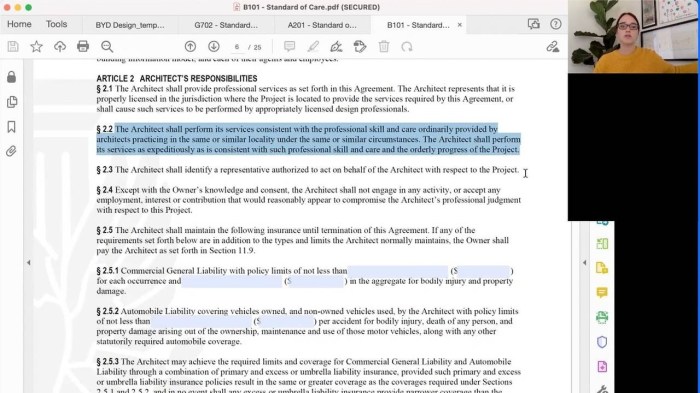
- Standard of Care: Establishes the level of professionalism and expertise that the architect is expected to adhere to.
- Construction Administration: Details the architect's role during the construction phase of the project.
- Termination: Sets forth the conditions under which either party can terminate the agreement.
Purpose and Scope of AIA B101
The American Institute of Architects (AIA) B101 contract document serves as a guide for establishing the roles and responsibilities of various parties involved in a construction project. It aims to provide a clear framework for project management and to ensure all parties are in agreement regarding the project scope, schedule, and budget.
Primary Objectives of AIA B101
- Define the roles and responsibilities of the owner, architect, and contractor.
- Establish the project scope, schedule, and budget.
- Provide mechanisms for resolving disputes and changes during the project.
- Ensure compliance with legal and regulatory requirements.
Scope of Work Covered by AIA B101
AIA B101 typically covers the following aspects of a construction project:
- Pre-construction services such as design development and cost estimation.
- Construction phase services including scheduling, quality control, and safety management.
- Post-construction services like warranties and closeout procedures.
Parties Involved in AIA B101 Agreements and Their Roles
- Owner:The entity commissioning the project, responsible for project funding and providing necessary approvals.
- Architect:Responsible for design, coordination with consultants, and ensuring compliance with project requirements.
- Contractor:Responsible for construction activities, scheduling, and quality control on-site.
Key Elements of AIA B101
In an AIA B101 contract, there are essential elements that must be included to ensure clarity and agreement among the parties involved. These elements Artikel the responsibilities and obligations of the owner, architect, and contractor, as well as the procedures for changes, payments, and dispute resolution.
Responsibilities and Obligations
- The owner is responsible for providing the necessary information, approvals, and payments to the architect and contractor.
- The architect is responsible for developing and coordinating the design, preparing construction documents, and providing administration services during the project.
- The contractor is responsible for constructing the project according to the contract documents, obtaining necessary permits, and coordinating with subcontractors.
Procedures for Changes
- Changes to the project must be documented in writing and approved by the owner, architect, and contractor.
- The process for changes should Artikel the procedures for pricing adjustments, schedule modifications, and any other necessary updates to the contract.
Procedures for Payments
- The contract should specify the payment terms, including the schedule of payments, retainage, and procedures for processing invoices.
- Payments should be made promptly upon completion of specific milestones or as Artikeld in the contract to ensure the project stays on track.
Dispute Resolution
- If disputes arise during the project, the contract should Artikel procedures for mediation, arbitration, or other methods of resolving conflicts.
- It is essential for all parties to work together to resolve disputes efficiently to avoid delays and maintain a positive working relationship.
AIA B101 vs. Other Contract Documents

When comparing AIA B101 with other commonly used construction contract forms, it is essential to understand the differences in structure, provisions, and clauses to determine the best fit for a construction project.
Structure and Provisions
- AIA B101: AIA B101 is known for its comprehensive and well-organized structure, outlining the roles and responsibilities of all parties involved in the construction project.
- Alternative Contracts: Other contract documents may vary in structure and provisions, sometimes lacking the clarity and specificity provided by AIA B101.
Clauses and Terms
- AIA B101: AIA B101 includes standard clauses that address key aspects such as project scope, schedule, payment terms, and dispute resolution mechanisms.
- Alternative Contracts: Other contract documents may have different clauses and terms, leading to potential ambiguity or misinterpretation if not carefully reviewed.
Advantages and Disadvantages
- Advantages of AIA B101:
- Clear Roles: AIA B101 clearly defines the roles and responsibilities of the owner, architect, and contractor, reducing the likelihood of disputes.
- Standardization: AIA B101 is a widely recognized and standardized contract document, providing familiarity and consistency in construction projects.
- Dispute Resolution: AIA B101 includes provisions for resolving disputes through mediation and arbitration, promoting efficient conflict resolution.
- Disadvantages of AIA B101:
- Rigid Structure: Some critics argue that the rigid structure of AIA B101 may not be suitable for all types of construction projects, limiting flexibility.
- Costly Amendments: Making amendments to AIA B101 can be time-consuming and costly, especially if significant changes are required to meet project-specific needs.
Epilogue
In conclusion, AIA B101 emerges as a cornerstone in construction agreements, with its detailed provisions and structured approach ensuring clarity and efficiency in project execution. Navigating the intricacies of AIA B101 equips stakeholders with a solid foundation for successful project outcomes.
FAQ Resource
What are the crucial elements of an AIA B101 contract?
The essential elements typically include project scope, responsibilities of parties, payment terms, dispute resolution mechanisms, and change order procedures.
Who are the primary parties involved in AIA B101 agreements?
The primary parties usually consist of the owner, architect, and contractor, each with distinct roles and responsibilities Artikeld in the contract.
How does AIA B101 differ from other construction contract forms?
AIA B101 is known for its detailed provisions and standardized format, distinguishing it from other contract documents that may vary in structure and clauses.